
If you’ve been handed the job of planning your company’s cocktail party, you’re probably not a bartender and you probably don’t want to become one just for one evening. That’s fair.
At Cheers Craft, we’re a bartending service for corporate events in Bangalore that takes care of the bar side of things, staffing, glassware, the drink menu, all of it, so whoever’s organizing the event can focus on the parts that actually need their attention. This guide covers what goes into planning a corporate cocktail party, and we’ve flagged where we usually step in to make life easier.
Quick Summary
Most people underestimate how much goes on behind a good corporate bar. Guest count decides staffing, Karnataka law requires a CL-5 excise license before you can serve alcohol, and where you place the bar can quietly make or break the evening. Here’s the short version before the full guide below.
| Step | What it covers | Typical numbers |
|---|---|---|
| Guest count and format | Standing mixer vs. seated dinner with cocktail hour | 20 to 150+ guests |
| Budget | Alcohol, bartending service, venue, food | Alcohol usually sourced by the host |
| Permits | CL-5 occasional liquor license from Karnataka Excise | ₹20,000/day standard, ₹40,000/day tatkal |
| Drink menu | Cocktail list built around the event and brand | 3 to 5 cocktails |
| Bar placement and staffing | Station layout, bartender-to-guest ratio | 1 bartender per 25 to 30 guests |
| Equipment | Bar counters, glassware, mixers, garnishes | Usually brought by the bartending vendor |
| Timing | Welcome window, open bar, last call | Fits your event’s runtime |
If you’d rather not plan all this yourself, you can get a custom quote for corporate bar staffing through Cheers Craft and we’ll sort out the staffing, menu, and setup based on your guest list and venue.
What Counts as a Corporate Cocktail Party
A corporate cocktail party is basically any company event where drinks are part of the plan, usually in the evening, usually standing or lounge-style rather than a sit-down dinner. Think product launches, year-end parties, client evenings, investor mixers, offsite socials, award nights. Most of these run one to three hours, open bar plus some food passed around, and the real point is networking rather than a formal program.
Because clients and leadership are often in the room, how the bar looks and runs matters more here than at, say, a birthday party. It’s a big reason companies bring in a proper bartending team instead of handing it to whichever employee has done bartending once at a house party. Most companies searching for bartending services in Bangalore for this kind of event want someone who can handle the whole bar end to end, not just pour drinks.
Step 1: Define the Guest Count and Format
Guest count is really the first domino. It decides staffing, budget, even venue layout. Roughly speaking:
Small events run 20 to 50 guests, usually a team or a close client list. Mid-size sits between 50 and 150, which is where most launches and year-end parties land. Anything above 150 counts as large, think town halls or company anniversaries.
Format matters too, and it’s worth deciding early. A seated dinner with a cocktail hour needs a different bar layout than a standing mixer where the bar is basically the centre of gravity for the whole room. Standing events tend to need more bar stations simply because people move around more. This is usually the first question we ask when someone reaches out, since almost everything else in the quote depends on it.
Step 2: Set a Realistic Budget
Corporate bar budgets generally split into four buckets: alcohol, bartending service, venue, and food. The bartending piece, staff, glassware, mixers, garnishes, ice, setup, is usually priced per guest per hour, and it scales up if the drink menu gets more elaborate. A basic two-cocktail setup costs less to run than a five-cocktail menu with premium spirits and a lot of garnish work.
One thing that catches first-timers off guard: most bartending services here, us included, handle the bar setup, staffing, glassware, and mixers, but the alcohol itself is sourced separately by the company. It sounds odd at first but it actually keeps things transparent, and it means the host still controls which brands show up, which matters if there’s a vendor policy involved. We work off custom quotes for this reason, since no two guest lists or venues look the same.
Step 3: Handle Permits and Licensing
This step gets skipped more often than it should. Serving alcohol at a corporate event in Karnataka needs an occasional liquor license, the CL-5, from the state excise department, and this applies whether you’re in a private office, a rented hall, or on a lawn somewhere. After the May 2026 fee revision, the standard CL-5 costs ₹20,000 per day, with a faster tatkal option at ₹40,000 per day if you’re cutting it close on time.
Some venues, hotels especially, already carry their own liquor license, which skips this step entirely. Worth checking with the venue before anything else gets finalized, because applying separately at an unlicensed venue adds both cost and time you might not have.
If the Event Is at Your Own Office Building
A lot of corporate cocktail parties happen right at the company’s own premises rather than a banquet hall or hotel, and this changes what paperwork you need for the CL-5. On top of the standard excise application, expect to keep these ready:
- GST registration certificate of the company, since the excise department wants proof that the entity applying is a registered business and not an individual.
- Building NOC, a no-objection certificate from the property owner or the facility management team, confirming they’re fine with alcohol being served on the premises for that one evening. This one takes the longest to arrange in commercial complexes, since it often needs sign-off from a building management committee rather than a single owner, so it’s worth starting this conversation two to three weeks before the event.
- PAN card of the company, which goes alongside the GST certificate as identity proof for the business.
- A formal letter on company letterhead stating that the organization is hosting the event on the given date, at the given address, which the excise office uses to confirm the occasion is genuinely company-organized and not a private party routed through a business address.
Missing any one of these is usually what causes last-minute scrambling, since the excise office won’t process the application halfway. If your event is inside a coworking space or a shared office building, add extra time, since you may need NOCs from both the coworking operator and the building owner.
If any part of this license process feels confusing or you’re not sure which documents your building will ask for, this is exactly the kind of thing our team helps corporate clients sort out before the event date, so it doesn’t become a last-week fire drill.
Step 4: The Drink Menu
Three to five cocktails tends to work better for corporate crowds than a long list, since it keeps service quick and doesn’t need much staff briefing. A signature cocktail tied to the company or product is always a nice touch, and it’s the kind of thing people actually remember. At least one solid mocktail on the menu is worth having too, since not every guest drinks.
Step 5: Bar Placement and Staffing
This is the other one you’re handling directly, so just the essentials here. Bar layout affects how smoothly the evening runs more than people expect. One bartender per 25 to 30 guests is a reasonable rule of thumb, and once you cross around 80 guests, splitting into two smaller stations usually beats one big one, since it keeps queues from forming near the entrance.
Step 6: Coordinate Equipment and Glassware
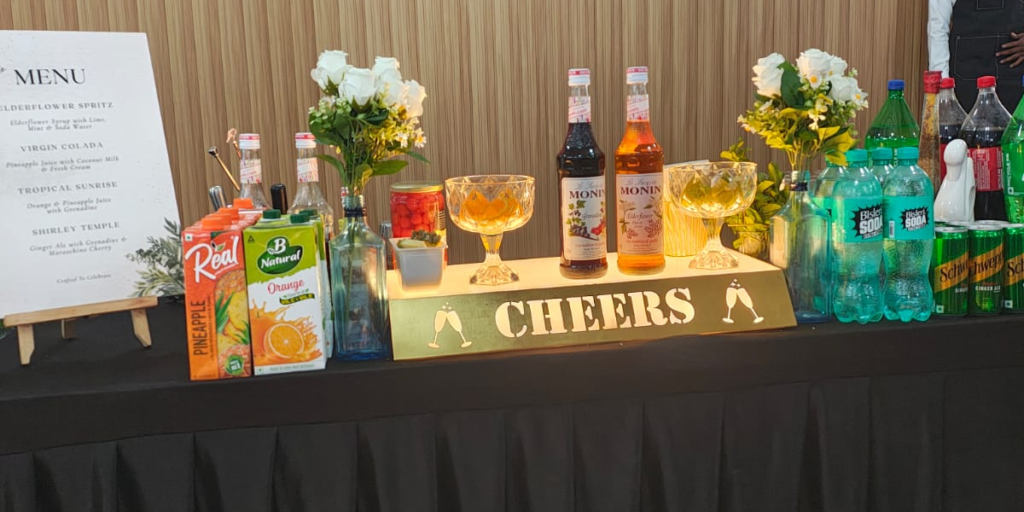
A lot of corporate venues aren’t actually set up with a working bar, especially offices, rooftops, and open lawns. A proper bartending vendor brings their own bar counters, glassware, ice, mixers, garnishes, and everything else, so the venue really only needs to provide space and power. Worth confirming with the venue ahead of time, since some banquet halls throw in glassware and some expect the vendor to carry everything. We bring our own equipment to every event, mostly because relying on the venue to have the right glasses is a gamble not worth taking.
Step 7: Time the Bar Service Correctly
Bar timing shouldn’t just run open from start to finish. For a typical three-hour evening, a 30-minute welcome drink window followed by two hours of open bar, then a last call about 20 to 30 minutes before wrap-up, tends to work well. It keeps the energy steady without guests being served right up until the lights come on, which matters for both the vibe and for basic guest safety.
Bringing It Together
A corporate cocktail party works when the bar just runs, no long queues, no confusion, nobody noticing the logistics because there aren’t any problems to notice. That takes the right staffing ratio, a tight menu, the correct license sorted early with all the paperwork in order, and a setup that actually fits the venue. Skip any of these and it shows up fast on the night; get them right and the actual point of the event, whatever that is for you, gets the attention it deserves.
If you’re planning a corporate event in Bangalore, Cheers Craft bartenders can take the bar side off your plate entirely, setup, staffing, and menu, built around your guest count and venue. And if you’re already looking for a bartender for corporate events in Bangalore, get in touch for a quote and we’ll work out the plan around your headcount, budget, and date.